


TauEB Research on Advanced Plasma Confinement Presented at EPS 2026
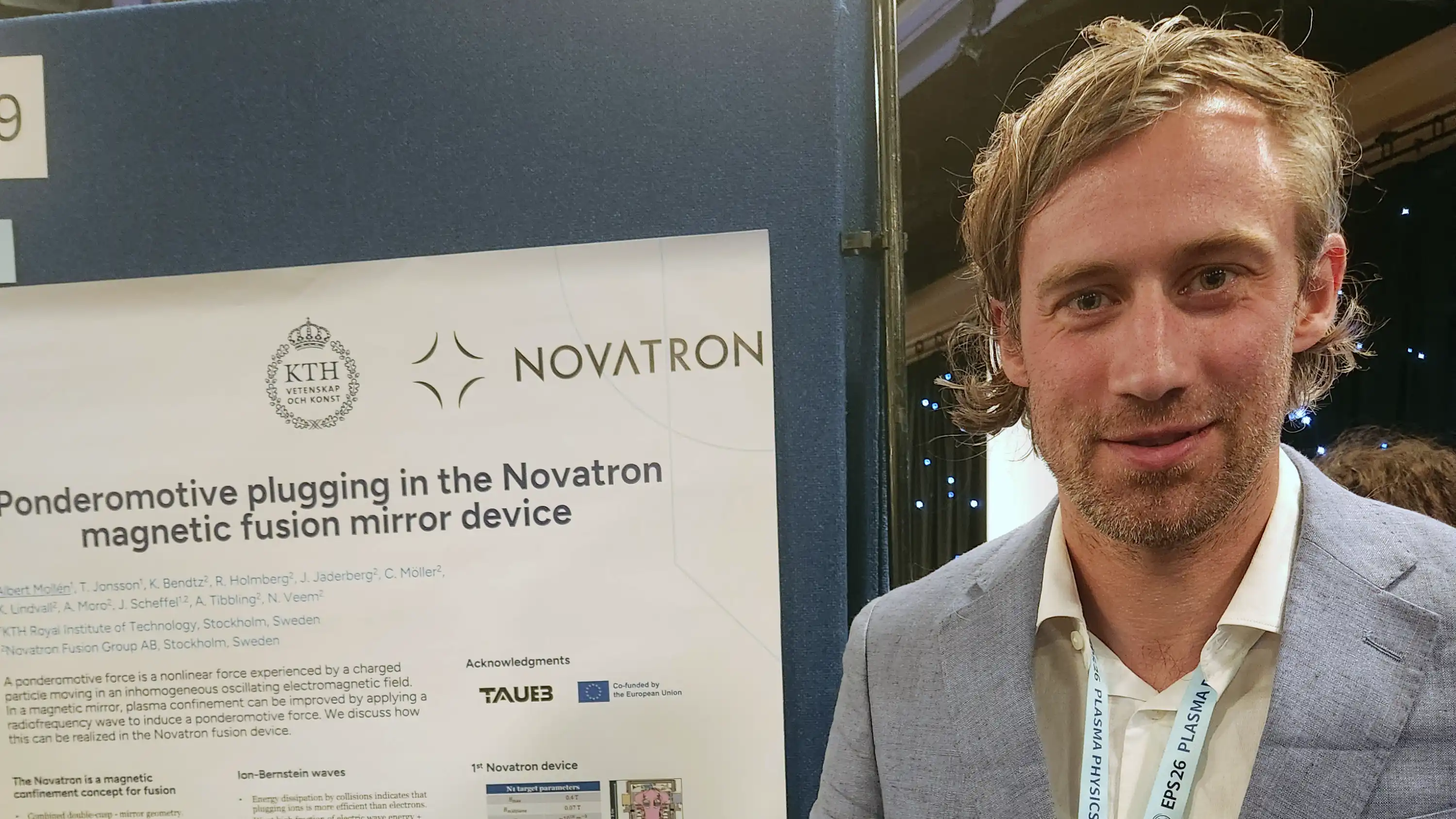
Researchers from the TauEB project and KTH Royal Institute of Technology showcased recent advances in magnetic mirror fusion research at the 52nd European Physical Society (EPS) Plasma Physics Conference, held in Edinburgh, United Kingdom, from 29 June to 3 July 2026.
The EPS Plasma Physics Conference is one of the world's largest gatherings of plasma physicists, bringing together hundreds of researchers from leading universities, research institutes, and laboratories to share the latest developments in fusion energy and plasma science.
Albert Mollén from KTH presented the contribution “Ponderomotive Plugging in the Novatron Magnetic Fusion Mirror Device”, which explores a promising method for improving plasma confinement in magnetic mirror fusion systems.
"The EPS Conference is always a good occasion to hear about the latest advances in plasma research and meet collaborators for discussions", says Albert Mollén.
The study investigates a technique known as radiofrequency (RF) plugging, which aims to reduce particle and energy losses from the plasma. The concept relies on the ponderomotive force, a force experienced by charged particles moving through an inhomogeneous oscillating electromagnetic field generated by plasma waves. By creating an additional confinement effect, RF plugging has the potential to enhance plasma performance and improve the overall efficiency of fusion reactors based on magnetic mirror configurations such as Novatron.
Closely connected to ongoing development
The research is closely connected to the ongoing development of the N1 experimental device at KTH. Operational since early 2025, N1 is currently being upgraded with new experimental capabilities that will enable researchers to investigate RF plugging under realistic plasma conditions.
The planned experiments, scheduled to begin in 2027, will provide valuable insights into the practical implementation of RF plugging and its potential role in future fusion energy systems. The results are expected to contribute to the continued development of the Novatron concept and support the broader goal of advancing magnetic confinement fusion as a sustainable energy source.
Through participation in international conferences such as EPS Plasma Physics, the TauEB project continues to share its research with the global fusion community while strengthening collaborations within the field.